
A panel interview brings multiple interviewers together to assess one candidate in a single conversation. Done well, it helps hiring teams compare perspectives, evaluate candidates consistently, and make decisions faster.
But without clear roles and a structured approach, interview panels can quickly become chaotic. Candidates face overlapping questions, interviewers focus on different criteria, and debriefs turn into competing opinions.
Here's how to run effective panel interviews, from choosing your interviewers and preparing questions to collecting feedback and making better hiring decisions.
What is a panel interview?
A panel interview is a hiring interview where two or more interviewers assess one candidate at the same time. Each panelist typically focuses on different skills, experiences, or competencies, giving the hiring team multiple perspectives from a single conversation.
Interview panels often include the hiring manager, a subject matter expert, and a cross-functional colleague. They're particularly useful for senior or collaborative roles where several stakeholders need to evaluate the candidate before making a hiring decision.
Panel interviews are sometimes confused with group interviews, but they're different formats.
| Interview type | Format | Best used for |
|---|---|---|
| Panel interview | Multiple interviewers assess one candidate together | Senior, technical, or cross-functional roles |
| One-on-one interview | One interviewer assesses one candidate | Initial screens and focused competency assessments |
| Group interview | Multiple candidates participate in the same interview | High-volume hiring and collaborative exercises |
| Sequential interviews | A candidate meets different interviewers separately | In-depth evaluation across several competencies |
The main advantage of a panel interview is that everyone hears the same answers firsthand. But to make that shared perspective useful, interviewers need clear responsibilities, consistent evaluation criteria, and a structured approach to collecting feedback.
Panel interviews: Benefits and drawbacks.
Panel interviews can make hiring faster and more collaborative, but they're not the right format for every role. The benefits depend on how well the interview is structured and how effectively panelists work together.
Benefits of panel interviews.
- Faster hiring decisions: Multiple stakeholders can assess a candidate in one session, reducing the need for separate interview rounds.
- Broader perspectives: Hiring managers, technical experts, and cross-functional colleagues can evaluate different competencies and identify strengths others might miss.
- More consistent evaluation: Panelists hear the same answers firsthand, making it easier to compare evidence and discuss candidates against shared criteria.
- Better stakeholder alignment: Interview panels give decision-makers a shared understanding of each candidate, reducing disagreements caused by incomplete information.
Drawbacks of panel interviews.
- More pressure on candidates: Facing several interviewers at once can feel intimidating, particularly if questions come from multiple directions.
- Risk of groupthink: Senior or outspoken panelists can influence others, especially when interviewers discuss impressions before submitting independent feedback.
- Scheduling complexity: Coordinating multiple interviewers can delay the process, particularly for busy hiring teams.
- Repetitive or disjointed questions: Without clear responsibilities, panelists may overlap, interrupt each other, or leave important competencies unexplored.
Most of these drawbacks are manageable. Clear interviewer roles, structured questions, independent scorecards, and a designated facilitator help interview panels stay focused and make better decisions.
What goes wrong when one panel covers everything.
A panel with no plan fails in a few predictable ways, and each one has a fix you can put in place before the call.
When every interviewer is trying to assess the whole candidate, the questions bunch up around whatever is easiest to ask, and the candidate tells the same story about the same project twice. Meanwhile a competency the role needs gets no questions at all, and no one notices until the debrief.
Somebody also ends up taking notes, and whoever writes stops listening, so the follow-up a vague answer needed never gets asked.
After the call, if the debrief opens with someone asking the room what it thought, the first answer sets the frame, and the most senior voice is often the one that gives it. That is how interviewer bias gets into a decision without anyone choosing it.
Panel interview best practices start before the call.
Most of what makes a panel work is decided before the candidate joins: what each interviewer is listening for, and what a good answer sounds like when they hear it.
Start with the competencies. Agree with the hiring manager on the handful the role needs, then write down what a strong answer and a weak answer sound like for each. An interview rubric is the place to put that, so every panelist scores against the same description.
Then give every competency one owner. Each panelist takes one or two that no one else on the panel is scoring, and the part they play on the call follows from what they own.
| Panelist | What they own | What they do on the call |
|---|---|---|
| Lead interviewer | How the candidate handles the room, and the clock | Explains the format and keeps time. Hands each block over, then closes with the candidate’s own questions. |
| Functional expert | Depth in the work itself | Runs the block on a hard decision the candidate made in a similar role. |
| Cross-functional partner | Collaboration and communication | Runs the block on working with people who wanted something different. |
| Team or values interviewer | How the candidate handles disagreement | Runs the block on group decisions and pushback. |
Before the first panel for a role, run a short calibration. The panelists score one sample answer on their own and then compare, because two people giving the same answer different scores is much cheaper to find out before a candidate is in the room.
Run the hour in blocks.
On the call, each interviewer gets a block of the hour, and the panel moves through the blocks in turn, so the candidate always knows who is asking and why.
Open by telling the candidate who covers what, and when they’ll get to ask their own questions. Then give each block one lead. The others hold their questions until that block ends, which stops the free-for-all where everyone jumps in on the answer they find most interesting.
Leave room in each block for follow-ups. A plan with a new question every five minutes looks thorough on paper and leaves no time for the second question, which is usually the one that tells you something.
If the call isn’t being recorded, give the note-taking to whoever isn’t leading the current block, and rotate it as the blocks change, so the person asking the questions is never also the one writing.
12 panel interview questions to ask candidates.
Good panel interview questions reveal how candidates think, solve problems, and work with others. Each panelist should focus on specific competencies, with follow-up questions that dig into the candidate's actual experience.
Here are 12 useful questions, grouped by the skills they help assess.
Collaboration and communication.
These questions help interview panels understand how candidates work across teams, communicate with stakeholders, and handle different perspectives.
- Tell us about a time you worked with stakeholders who had competing priorities. How did you reach an agreement?
- Describe a situation where you had to explain a complex idea to someone without your technical expertise.
- Tell us about a disagreement with a colleague that changed your approach to a project.
What to listen for: Clear communication, active listening, respect for different perspectives, and specific examples of how the candidate contributed to a successful outcome.
Problem-solving and decision-making.
Use these questions to understand how candidates approach unfamiliar challenges, evaluate tradeoffs, and make decisions under pressure.
- Walk us through a difficult problem you solved with input from multiple teams.
- Describe a time you had to make an important decision with incomplete information.
- Tell us about a project that didn't go as planned. What did you do to get it back on track?
What to listen for: Structured thinking, sound judgment, ownership of decisions, and the ability to explain why a particular approach was chosen.
Leadership and accountability.
These questions are particularly useful for management and senior roles, but can also reveal initiative and ownership in individual contributors.
- Tell us about a time you had to make an unpopular decision. How did you bring others along?
- Describe a situation where you took responsibility for something outside your formal role.
- Give an example of how you've helped a colleague or team improve their performance.
What to listen for: Accountability, initiative, self-awareness, and evidence that the candidate can influence outcomes without relying solely on authority.
Adaptability and role-specific skills.
These questions explore how candidates respond to change and apply their experience to the challenges they'll face in the role.
- Tell us about a time project requirements changed unexpectedly. How did you adapt?
- What's the most challenging technical or functional problem you've solved in your current role?
- If you joined our team and encountered [a realistic role-specific challenge], how would you approach it?
What to listen for: Flexibility, practical expertise, curiosity, and the ability to apply relevant experience to new situations.
Ask follow-up questions, not just prepared ones.
A panel interview shouldn't feel like four people reading questions from a spreadsheet. Prepared questions create consistency, but follow-ups are often where the most useful evidence emerges.
Ask candidates to clarify their individual contributions, explain their reasoning, or describe what they'd do differently. Assigning competencies to each panelist helps avoid repetition while giving interviewers room to explore interesting answers.
The goal is to collect comparable evidence of candidate skills, not force every conversation through an identical script.
The questions each interviewer owns.
Each panelist’s questions come from the competencies they own, and each owner needs one strong question per area with time to follow it up. I’d rather give each panelist one question to dig into than five to get through.
| Area | Owner | Question to ask | What to listen for |
|---|---|---|---|
| Collaboration and communication | Cross-functional partner | “Tell us about a time you had to align stakeholders with very different priorities.” | A clear structure, and one answer that deals with more than one point of view. |
| Role-specific depth | Functional expert | “Walk us through a challenging decision you made in a similar role.” | The trade-offs they weighed, and what they owned when the outcome went badly. |
| Culture and values | Team or values interviewer | “How do you handle disagreement in group decisions?” | Whether they push back with respect or go along to keep the peace, and whether they know which they tend to do. |
| Handling the room | Lead interviewer | No set question. Watch the handoffs. | How they deal with an interruption, and whether they adjust the answer to the person who asked. |
The last row has no set question on purpose. How a candidate handles several people at once shows up in the handoffs between blocks and in what they do when two panelists ask at the same time.
For more options in the collaboration block, there is a full list of communication skills interview questions with follow-ups to dig deeper.
Score before the debrief starts.
The hour after a panel is where the decision gets made, and the order things happen in sets how much of the panel’s evidence makes it into that decision.
The rule I’d hold to: the scorecards go in first, with every panelist writing and submitting theirs before anyone in the debrief says what they thought.
Then open the debrief on the evidence, one competency at a time, with its owner saying what the candidate said and what score they gave. When the panel gets to an overall view, the most junior panelist speaks first, so seniority doesn’t set the frame.
Hold the debrief the same day or the next, because a strong candidate keeps talking to other companies while the panel waits.
A separate guide to wash-up meetings is about the debrief a recruiter runs once the interviews are over, and how to keep that meeting on the evidence.
Sample 60-minute panel interview agenda.
A clear agenda helps interview panels cover the right competencies without rushing candidates or repeating questions. Here's an example of how to structure a 60-minute panel interview with three interviewers.
| Time | Activity | Owner |
|---|---|---|
| 0–5 minutes | Introductions and interview overview | Facilitator |
| 5–15 minutes | Relevant experience and background | Hiring manager |
| 15–30 minutes | Technical or role-specific competencies | Subject matter expert |
| 30–45 minutes | Collaboration and behavioral questions | Cross-functional panelist |
| 45–55 minutes | Candidate questions | Full panel |
| 55–60 minutes | Next steps and closing | Facilitator |
The exact timing will depend on the role and seniority. What's important is that every panelist knows which competencies they own, how much time they have, and when to hand over to the next interviewer.
After the interview, panelists should complete their scorecards independently before discussing the candidate. This helps prevent stronger personalities from influencing everyone else's evaluation.
When a panel is the wrong format.
A panel costs several people an hour each, so save panels for shared decisions, the late-stage calls that several stakeholders have to agree on. Earlier than that, it slows the process down for little in return.
- You’re screening a high volume of early-stage candidates
- The role has narrow or repetitive skill requirements
- Panelist availability or seniority can’t be balanced
- The role is cross-functional or high-impact
- The decision needs sign-off from three or more stakeholders
- You’ve already screened for basic fit and motivation
When the panel can’t be balanced, I’d run two shorter interviews with the same split of competencies instead of one lopsided panel.
Make panel interviews more effective with Metaview.
Panel interviews generate plenty of useful information. The challenge is capturing it consistently and turning it into a clear hiring decision.
When every panelist takes their own notes, important details can get lost. Interviewers may remember different answers, focus on different evidence, or struggle to explain why they reached a particular conclusion.
Metaview helps hiring teams capture the full conversation and evaluate candidates against shared criteria, without adding more administrative work.
- Capture complete interview evidence. Metaview automatically records and summarizes panel interviews, so interviewers can focus on the candidate rather than typing notes.
- Create consistent, evidence-backed scorecards. Turn interview conversations into structured feedback aligned with your hiring criteria. Panelists can review the same evidence before making their evaluations.
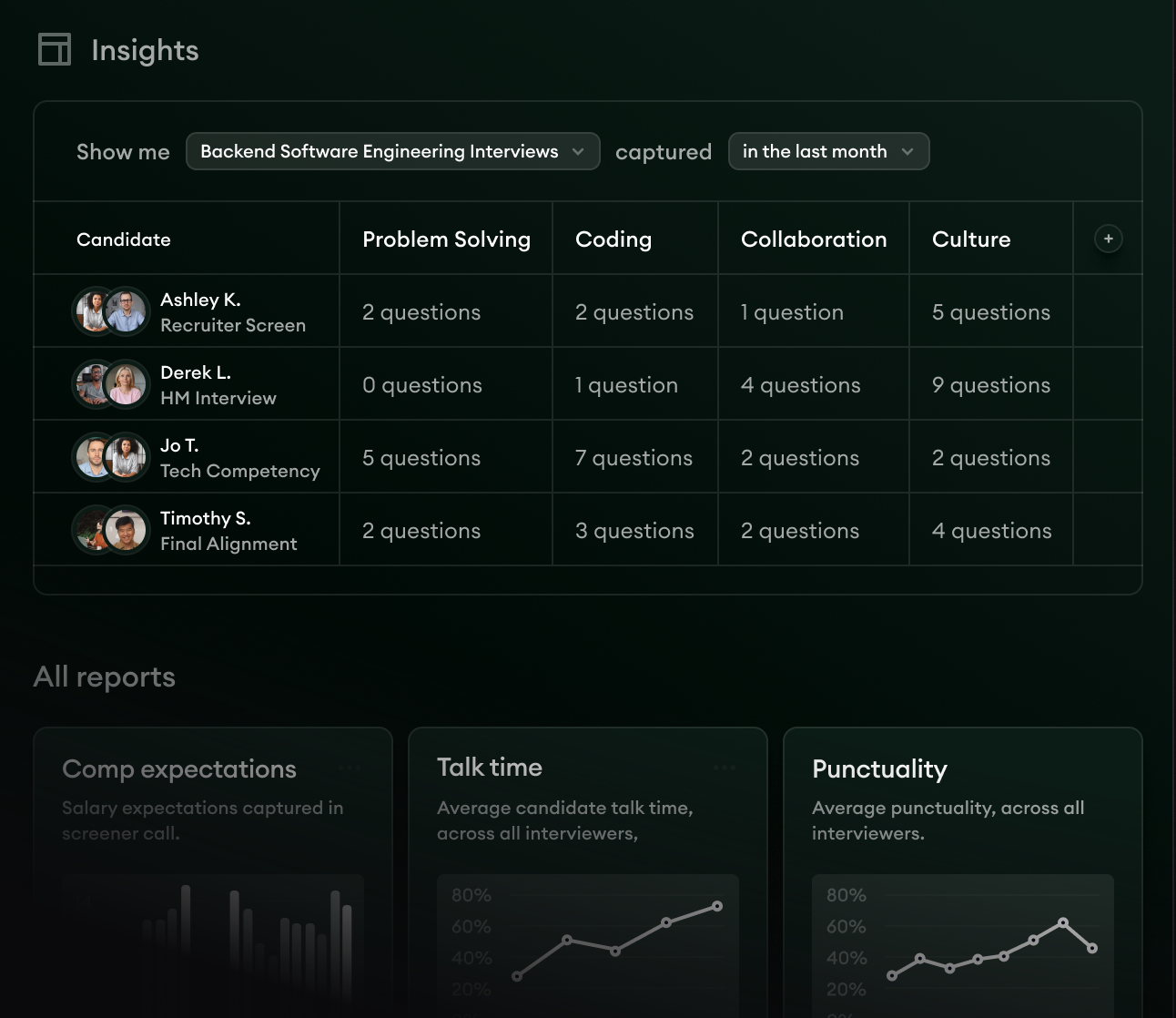
- Improve interviewer performance. Metaview Reports helps recruiting teams identify patterns across interviews, spot gaps in questioning, and coach interviewers to run more effective conversations.
The result is a more consistent interview process, with better evidence for hiring decisions and less time spent chasing notes or reconstructing conversations.
Fiona Keating, director of talent acquisition at SoSafe, puts the aim this way: “We’re using Metaview to create stronger hiring signals, better calibration across interviewers, and a really high-quality experience for candidates as well, regardless of the interviewer.”
Panel interviews work best when every interviewer brings a different perspective but evaluates candidates against the same hiring bar. Metaview makes that easier by keeping the evidence organized, accessible, and ready for the hiring team to review.
Contribute without dominating. You’re part of a hiring committee, but the final decision isn’t yours to make alone.”

Across many panels, Metaview Reports lets the team query its own interview data and compare question coverage across interviewers and roles. A competency with no questions against it is the gap the split was meant to close, and the count shows which interviews keep missing it.
For a panel, that last phrase is the test: when every panelist scores from the same record, the standard shouldn’t depend on who happened to be on the call.
Is your panel doing its job?
The scorecards from your last few panels will tell you. Pull them for one role and run these checks. Where one fails, fix the failing step first.
- Every competency has exactly one rating per candidate. Two ratings on one competency and none on another means the split slipped, so fix the plan before you touch the questions.
- Every rating has the candidate’s own example under it. Where one doesn’t, check whether its owner had time for a follow-up in their block.
- Every scorecard was in before the debrief started. If any came in after, move the next debrief later until they’re all in.
- The same person doesn’t open every debrief. If the most senior voice always goes first, set the speaking order before the next one. A guide to running an interview debrief takes that meeting step by step, from reading the written feedback to making the call.
If I could change one thing before your next panel, I’d give every interviewer a different job on paper: the competencies they own and the block they’ll run, sent out the day before. Everything else in this guide gets easier once no one on the call is trying to cover the whole candidate.
Give every panelist the same record to score from.
Metaview’s Notetaker records the panel interview, and Metaview drafts a scorecard from the conversation for review before the debrief.
Panel interview FAQs.
Who should be on an interview panel?
Most interview panels include a hiring manager, a subject matter expert, and a cross-functional colleague. Each person should assess different competencies relevant to the role. Keep panels small enough to allow meaningful conversation, typically three or four interviewers.
What's the difference between a panel interview and a group interview?
A panel interview involves multiple interviewers assessing one candidate at the same time. A group interview involves multiple candidates participating in the same session, often through shared questions, discussions, or practical exercises.
What are the disadvantages of panel interviews?
Panel interviews can be intimidating for candidates, difficult to schedule, and vulnerable to groupthink. Without clear interviewer responsibilities, they can also lead to repetitive questions and inconsistent evaluations. Structured questions, independent scorecards, and a designated facilitator help reduce these risks.
How should interviewers prepare for a panel interview?
Start by agreeing on the competencies you're evaluating and assigning each panelist specific areas to cover. Prepare questions and scoring criteria in advance, review the candidate's background, and establish a clear agenda. Interviewers should also agree on how they'll capture feedback and conduct the debrief.
How do you avoid bias in panel interviews?
Use consistent evaluation criteria, ask comparable questions, and require interviewers to submit independent feedback before discussing candidates. Base assessments on specific evidence from the interview rather than personal impressions or perceived cultural fit.


